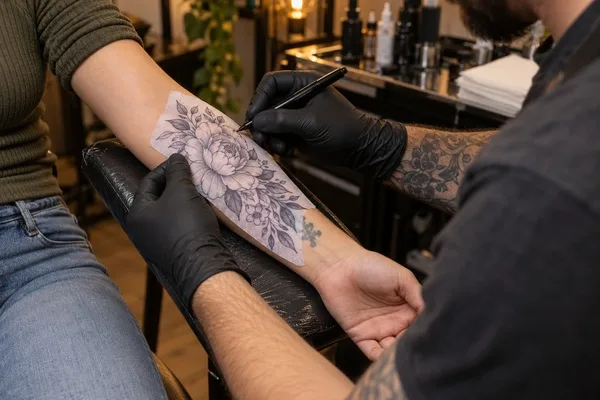
Yes, an ex's name can almost always be covered. Cover-up tattoos are one of the most common requests we get, and a name is usually one of the easier jobs. It works when the new design is planned around the old ink: its size, how dark it is, and where it sits on your body.
Nobody here is going to ask what happened. You want it gone, and we want you to love what replaces it. If you'd like to talk it through first, get in touch with our studio or call (407) 725-7072.
Why does the old tattoo's size, saturation, and placement matter?
Because the new tattoo has to physically hide the old one, and ink doesn't erase ink. It layers on top. The old name sets the minimum size of the new piece, its darkness sets which colors can work, and its placement decides which shapes will flow with your body.
A thin script name from ten years ago, softened by time, is a very different job from a bold, fresh name packed with black. Faded linework gives us room. Heavy saturation means we need more dark areas in the new design to bury it.
Placement matters too. A name across the forearm runs sideways, so a design that wraps the arm often covers it better than one stacked straight up. Ribs, wrists, and the back of the neck each come with their own limits on how big we can go.
Plenty of people who got a name in their Rollins College days assume they're stuck with a giant black blob over it. Usually they aren't. Our cover-ups page shows real before photos and the stencils we built over them, so you can see what's possible.
How do artists fully hide an old name with a new design?
With darker tones, smart shading, and an image big enough to swallow the old lines. Light colors can't sit on top of dark ink and hide it, so the darkest parts of the new tattoo get placed over the letters.
Texture does a lot of the heavy lifting. Leaves, feathers, flower petals, fur, and wood grain all have natural shadows and busy edges, which give us places to bury a capital letter or a looping "y." Clean geometric shapes and open negative space are much harder, because there's nowhere for old lines to hide.
Size is the part people push back on most. The cover-up will be bigger than the name, often noticeably. Think of a short walk down Park Avenue: you'd notice a name tattoo on someone's arm, but your eye slides over a full floral piece. That's the effect we're after.
Bigger pieces can mean more time in the chair. If you'd like to see where you'll be sitting, our studio gallery shows the space behind the red doors on Howell Branch Road.
When is a laser lightening session recommended first?
When the old ink is too dark, too big, or too close to where you want open space. A few laser sessions can fade the name enough that the cover-up can be smaller, lighter, or more detailed than it could be over the original ink.
Laser isn't always needed. Plenty of names can go straight under a good design. But if the old tattoo is solid black lettering and you're hoping for something with soft color or fine detail, lightening it first usually gets you closer to the tattoo you actually want.
The trade-off is time. Your skin needs to heal between laser sessions and again before tattooing, so lightening adds weeks or months to the plan. Healing skin also needs to stay out of the sun, so a summer of boat days on Lake Virginia may have to wait. Many clients use that stretch to get the design just right.
We'll tell you honestly at the consultation whether laser would make a real difference for your tattoo, or whether we can go straight to the cover-up.
What should you bring to a cover-up consultation?
Bring the tattoo itself, a few clear photos of it in good light, and pictures of styles or subjects you like. Add a rough idea of how big you're willing to go. That's enough for us to tell you what will work.
One guy came in wanting to cover an old name on his forearm, but he didn't want it to turn into a massive eyesore. We were honest about what was and wasn't possible with the ink he had. He'd brought pictures for a botanical theme, so we worked with that and made something he actually wanted to wear.
Those pictures made the difference. They told us his taste, and the botanical style gave us leaves and shading to work with over the old letters. Even a few saved screenshots on your phone help more than you'd think.
Ready to stop looking at that name? Book a cover-up consultation with Chyloe, one of our cover-up artists, or call (407) 725-7072 to talk it over. If you have questions before you book, contact our team and we'll help you plan the next step.